Encrypted Dmg
I don’t know about you, but I still haven’t got over the death of TrueCrypt. It was a fantastic program for making encrypted folders in all respects, and its demise was totally unexpected.
Now I know that it has a successor – VeraCrypt – and it is more or less twin siblings. But VeraCrypt still doesn’t feel the same. And I have had lots of issues opening encrypted folders using VeraCrypt, and losing valuable files in the process.
Btw, there is a very basic security problem with dmg encrypted images. Consider your mac is confiscated in UK. They found encrypted.dmg file on your disk and because of the law in UK they force you to reveal the password (keeping you in jail). You have a same problem with FileVault.
DMG Backup Extractor allows Windows users to open Apple Mac.DMG disc image files and extract the files within to their Windows PC. These DMG disc images are created on Apple Mac computers and are often sent to Windows users unaware that Windows does not natively supported the DMG file format. DMG Extractor is probably the first and only tool designed exclusively to deal with DMG files on Windows OS. Since DMG Extractor is developed specially for DMG files, it can open encrypted.DMG files without having to first convert them to other formats. Raw, Bzip2, Zlib, and Zero block type DMG files are supported by DMG Extractor. The reason it’s so slow is because your AES256-encrypted DMG uses 250,000 rounds of PBKDF2-HMAC-SHA-1 to generate the encryption key. The ludicrous round count makes it extremely computationally expensive, slowing down the HMAC-SHA1 process by a factor of 250,000. DMG Extractor is ideal if you need to: Extract content from an Apple.dmg file; Extract the.IPSW restore file from an iOS beta; Extract contents from IPA files; Functionality & features. It automatically extracts the contents of the files to your computer; Opens encrypted or non-encrypted DMG files; Extract 4GB+ DMG files. To unmount the encrypted disk image, click the Eject button under Devices in Finder or right-click or Ctrl+click its desktop icon and select the “Eject” command. Mount the Encrypted Disk Image. To mount the encrypted disk image in the future, locate its file on your hard drive—it will have the.dmg file extension—and double-click it.
But if you use a MacOS computer, then you don’t need VeraCrypt, because Disk Utility will make your encrypted folders for you.
Encrypted Folders With MacOS Disk Utility
It wasn’t that long ago that I showed you how to format a USB stick or SD card using Disk Utility. Many MacOS users routinely overlook Disk Utility, but it is really a nifty little program. The encryption abilities is just the icing on the cake.
An encrypted folder on MacOS has the file format DMG (similar to many MacOS software installation programs). DMG stands for “Disk Image”, and is not much different than an ISO file on Windows. Once the DMG folder has been created, you simply “mount” it to open it, and you can start dragging items in.
The process to make an encrypted DMG folder is absurdly simple.
Open Up Disk Utility
Obviously you are not going to get very far without opening Disk Utility! You will find it in the “Utilities” sub-folder of the “Applications” folder. It doesn’t matter which area of the computer is currently highlighted. When it comes time to make the disk image, you will be asked where you want to save it.
Start a New Blank Image
Go to the Menu bar and choose File–>New Image–>Blank Image.
Start Filling Out The Details Of The Encrypted Folder
Here is where you set up and configure the container to your specifications. Let’s go through each one.
- Save As : What you want it to be called on the computer. This will be the name seen by everyone who has access to your computer.
- Where : Where on the computer you want to save the newly created folder. Obviously you can move this afterwards. It is not fixed in one place.
- Name : The name you alone will see when it is mounted and open on the MacOS system.
- Size : The size you want your container to be. One important thing to note is that whatever size you specify will be instantly taken by your computer. So if you specify 100MB, then 100MB will be immediately deducted from your hard drive space – even if there is nothing in the folder yet.
- Format : Always choose MacOS Extended (Journaled).
- Encryption : See the next section for this part.
- Partitions : Always choose Single partition – GUID Partition Map.
- Image Format : If you want to add and remove files from the image file, then choose read/write disk image.
Choose Your Encryption Protocol
When you drop down the Encryption menu, you are given 2 options. 128-bit AES encryption, and 256-bit AES encryption.
Essentially, both are extremely secure, but the 256-bit version is more secure than the 128-bit version. The only downside (as the menu says) is that if you encrypt with 256-bit, you are going to see a noticeable time-lag.
However, unless you are hiding Top Secret files, or running Wikileaks from your MacOS computer, then the 128-bit version will be more than sufficient.
Set The Password
When you choose the encryption standard that you want, it will immediately ask you to set a password. Obviously it goes without saying to choose an extremely strong password. No dictionary words. Instead, a combination of letters and numbers.
If you can’t think of one yourself, you can make it easier on yourself, by clicking the key icon, and a Password Assistant will open up. Next to “Length“, slide the slider along to the number of characters you want. Under “Type”, choose which kind of password you want. As I said, the letters and numbers one is the most secure, but ultimately it is up to you.
It will then show you a password you can use under “Suggestion”, and under “Quality”, the green bar will tell you how secure it thinks the password is. If for some reason you don’t like that password suggestion, drop the menu down, and you will get lots more suggestions.
Choose one, then copy and paste the password into a secure document. If you lose the password, you lose access to the disk image!
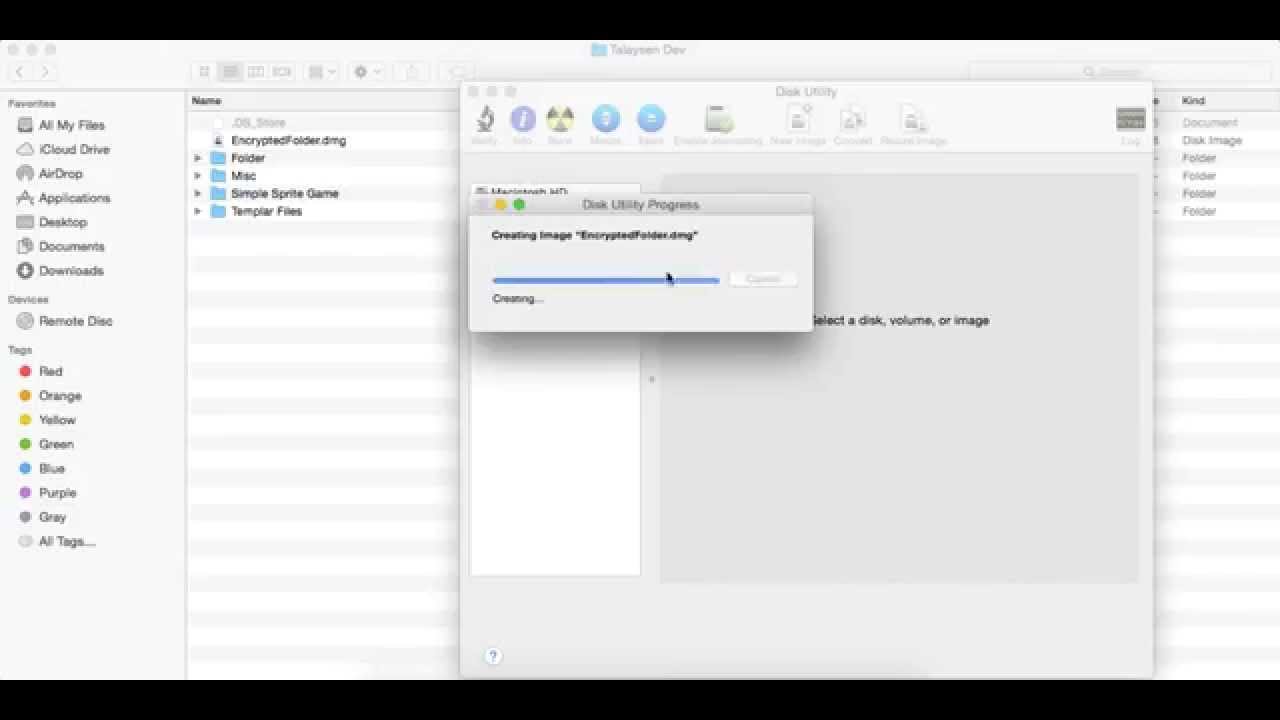
Wait For The Encrypted Container To Be Made
When you have filled in all of the details, and you have clicked “Save”, it will create the disk image folder for you. When it has been made, click “Done”….and you are done.
Go to the Finder location where you told it to save the disk image, and it will be sitting there open waiting for you. To access it, go to the folder name in “Devices”.
Double-Click To Mount & Open The Folder
To normally open the folder (such as when it is closed), double-click the DMG file and a window will jump up, demanding the password. It should be noted at this point that you cannot copy and paste passwords into the box. You need to type them manually.
For obvious reasons, you do not want to have checked “Remember password in my keychain“. Otherwise, when you put the mouse cursor inside the password box, the password will automatically be entered!
Kind of defeats the whole purpose of encryption doesn’t it?
Drag Your Files Inside The New Window
Once you have successfully entered the password, the folder will appear in the Devices section. Click on it to enter the folder. You can now view the contents, delete files from the folder, and add new files.
When you want to close the encrypted disk image folder again, click the upwards arrow icon next to the folder name. This will dismount the folder and close it.
Conclusion
TrueCrypt and VeraCrypt may have its legions of fans (and I was one of them). But MacOS (and Windows, for that matter) have their own built in encryption tools. You just have to know where to look.
In computing world, DMG or (Disk Image File) is a file extension that belongs to Mac OS X. DMG file can also be termed as Apple Disk Image. The icon used equivalent to this file is an Internal Hard-drive. Disk Images are generally used worldwide in-order to distribute applications and software across the Internet. DMG file provides some attractive features that allow securing password along with file compression.
These virtual or physical Apple disks can be cloned from one to another. This is one of the powerful features of Mac.
Tip: If you want to open and view DMG files of Apple Mac OS X so, you can try DMG Viewer tool.
Description Wondershare TunesGo 9.7 Dmg For Mac + OverviewA expert software to address the tune and tunes, Wondershare Tunesgo 9.7 for mac provides a complete strategy to skip the itunes and media documents to iphone and android gadgets. Wondershare TunesGo 9.7 offline installer complete setup for mac OS with direct link. Wondershare TunesGo 9.7 dmg for mac free download full version. 
Why DMG Files Are Created?
Earlier, Mac applications made use of Resource fork. These are the part of file system on Mac Operating System, which consists of both the structured data and non-structured data. Mac could not transfer these Resource forks over the mixed networks. Hence, the usage of Resource fork dwindled and this was the reason that Apple created disk image formats(DMG). The Resource forks are very important as they contain Meta data regarding the file.
Encrypted Dmg Change Password
Mounting and Dismounting on Mac OS
It is equivalent to plugging in a removable drive, where E drive is automatically created and while removing one chooses ‘Safely Remove Device’. Similarly, you have to eject the Mac drive for both the virtual and physical.
Two Disk Formats supported are:
Open Encrypted Dmg On Ipad
- NDIF
This was previously used as the default format of Mac, also known as New Disk Format. These files generally have an .img file extension. - UDIF
The native disk format of Apple Mac DMG file is UDIF (Universal Disk Image Format) with a file extension of .dmg.
MIME Type of DMG File:
application/x-apple-diskimage.
Supported File Systems
- Hierarchical File System (HFS) – This was developed by Apple Inc. for the systems supporting Mac OS. Earlier, these file systems were used in floppy disks and hard disks but later were used to read CD-ROM as well. It is known as Mac OS Standard.
- HFS Plus – It was developed after HFS, which is an extension of the same. It is known as Mac OS Extended.
- File Allocation Table (FAT) – It is a file system generally compatible with all file systems and helps in exchange of data between systems.
- ISO9960 – This is also a file system which was issued by ISO (International Organization for Standard) supporting various OS and helps in exchange of data.
- Universal Disk Format –This is a file system usually used to store broadcast media like DVD and optical disk formats.
How to Open DMG Files?
In Mac:
- When you download a Disk image, all the applications in it must be copied to the Application files, because many of these files will be in read-only format. Running these files inside the drives may produce some erroneous results.
- Double clicking the DMG File will open the file and you can view the contents in it. It might be images, documents, programs, etc.
- The DMG File consists of an application file. You can simply drag and drop to install them. If there is a possibility of having an installer, you can run these files instead of installing.
- Right-click on the File >> “Eject” (click on virtual disk instead of, original file)
Delete the old DMG Files after installing. The reason is old files may take more space when we install new programs.
Resize DMG Files
- Right click DMG File >> Click Get Info (View the original size).
- Open Disk Utility >>Select Images Tab>Click on Resize>>Select the DMG file to be resized.
- Click on Open >>Type the file size to be reduced>>Select Resize>>Done
In Windows:
Originally, DMG files are the default Disk Image file for Mac. Hence, they can be opened only on Mac OS.
Since there are no manual methods available to view the DMG Files in Windows, users can install external third-party software available online on Internet. DMG Viewer is one of the tools from such category.
The software provides you with the following features:
- Open DMG File in Windows OS based machine
- Read: Corrupt, Password Protected & Encrypted DMG
- Recover permanently deleted files from DMG
- Search a specific file type in large DMG Format Files
Conclusion
Considering the ongoing necessity to view DMG files, we have described a manual process to let the users understand how to open & view DMG files. Else, users can take the help of a reliable third-party tool named as DMG Viewer. It is the best application that helps to read .dmg files in Windows OS. Users can use any approach as per their choice.